"Every passion borders on chaos, that of the collector on the chaos of memory." Walter Benjamin, Ich packe meine Bibliotheck aus.
Showing posts with label reflections. Show all posts
Showing posts with label reflections. Show all posts
Wednesday, 24 April 2013

Wednesday, 6 March 2013
Childhood craze collection - Pokemon etc
There's something a little different about childhood crazes when thinking of collecting. In many ways the collection urge is as strong if not stronger than the most dedicated adult "serious" collection, yet often we don't know why we collect these things - the very conscious decision to become a collector of something is almost superceded by an instinctive need. Now we could say it was peer pressure or simply wanted to join in, but I think it is more than just that. I was struck when talking to my dad about his childhood collections in the 1950s how completely surreal some of them were - paper cut offs from the printer's for example - he had no idea why he collected them, but that was the craze amongst him and his friends, so he did it. I'm fascinated about when something as rational as collecting can become irrational.
I can strongly remember the crazes when I was little. There were the usual marble collections. And then there was a craze for yoyos, flower seed packets (?), friendship bracelets, and then there was the toys. Cabbage Patch Kids (no way according to my mum - but I remember the scenes of hysteria in the shops), trolls (likewise), my sister was obsessed with Beanie Babies, but I don't think there was anything like the current craze for Moshi Monsters, or that late '90s wonder that was Pokemon. Now I have a soft spot for Pokemon - Bulbasaur was my favourite as he was like a plant tortoise dinosaur - what's not to like - but even in the cartoon's catchphrase "gotta catch them all" there was a new marketing savvy insight into the different between a collection and a craze and the potential of combining the two. Kids I spoke to at the time who thought it was funny that I knew about Pokemon (this was their vs the grown up world's), didn't just want to complete their collection, they felt something was lacking if they were missing certain Pokemon. They felt they would be happier if they had them. I don't remember this strength of feeling when I was younger - I would have like more of the toys I liked but I didn't feel I was missing something vital - there was no craving - collecting wasn't an addiction. And whilst collecting can be like that for an adult collector, there it is a conscious thing, but with some of the kids I don't think they understood why they wanted these toys. Do you really love Pokemon was almost a confusing question. Why do you want all of them, even more so. I'd presumed kids wanted them because they liked the characters, that they were creating a fantasy world where they were powerful and could battle and win, that there were some they would want because they liked them best, but not others, that they essentially functioned like any child collection of the past - that they offered imagination expansion and escape, or at least complex games with their pals. But this seemed more like Dad and his paper cut offs - they didn't know why they collected them, and it seemed more about competition with their friends than competing in imaginary creature battles. It was almost collective collecting, yet rather than sharing, each wanted to have the most.
Now of course this is not the case for everyone - I'm certain there were thousands of children who genuinely loved the Pokemon world and played amazing games, and in many cases I may be over thinking this. And I'm not anti such collections even if I was being cynical of marketing forces etc. I also understand that both children and adults can have serious Pokemon collections, and I think that's as great as any other collection. There's no hierarchy of what's collected here on museeme! But I do think it's interesting to think of where collection meets craze, and whether the true collector (that can be of Pokemon!) thinks differently. I guess this could be answered by how craze collections tend to get moved on from and forgotten about when the next craze comes along, whereas with true collectors it can be a lifelong passion. Again I'm not putting a value judgement on that. I just find it interesting - things like how these crazes arise, where the next one will come from, how much they'll influence the childhood memories of the next generation - are we all partly formed by the crazes we live through? I don't know - but for now here's some photos of rather good Pokemon collections. Gotta catch 'em all, after all...
 From Dabid Robinson
 From Emakura
 From Kayleigh 29
And my personal fave

I can strongly remember the crazes when I was little. There were the usual marble collections. And then there was a craze for yoyos, flower seed packets (?), friendship bracelets, and then there was the toys. Cabbage Patch Kids (no way according to my mum - but I remember the scenes of hysteria in the shops), trolls (likewise), my sister was obsessed with Beanie Babies, but I don't think there was anything like the current craze for Moshi Monsters, or that late '90s wonder that was Pokemon. Now I have a soft spot for Pokemon - Bulbasaur was my favourite as he was like a plant tortoise dinosaur - what's not to like - but even in the cartoon's catchphrase "gotta catch them all" there was a new marketing savvy insight into the different between a collection and a craze and the potential of combining the two. Kids I spoke to at the time who thought it was funny that I knew about Pokemon (this was their vs the grown up world's), didn't just want to complete their collection, they felt something was lacking if they were missing certain Pokemon. They felt they would be happier if they had them. I don't remember this strength of feeling when I was younger - I would have like more of the toys I liked but I didn't feel I was missing something vital - there was no craving - collecting wasn't an addiction. And whilst collecting can be like that for an adult collector, there it is a conscious thing, but with some of the kids I don't think they understood why they wanted these toys. Do you really love Pokemon was almost a confusing question. Why do you want all of them, even more so. I'd presumed kids wanted them because they liked the characters, that they were creating a fantasy world where they were powerful and could battle and win, that there were some they would want because they liked them best, but not others, that they essentially functioned like any child collection of the past - that they offered imagination expansion and escape, or at least complex games with their pals. But this seemed more like Dad and his paper cut offs - they didn't know why they collected them, and it seemed more about competition with their friends than competing in imaginary creature battles. It was almost collective collecting, yet rather than sharing, each wanted to have the most.
Now of course this is not the case for everyone - I'm certain there were thousands of children who genuinely loved the Pokemon world and played amazing games, and in many cases I may be over thinking this. And I'm not anti such collections even if I was being cynical of marketing forces etc. I also understand that both children and adults can have serious Pokemon collections, and I think that's as great as any other collection. There's no hierarchy of what's collected here on museeme! But I do think it's interesting to think of where collection meets craze, and whether the true collector (that can be of Pokemon!) thinks differently. I guess this could be answered by how craze collections tend to get moved on from and forgotten about when the next craze comes along, whereas with true collectors it can be a lifelong passion. Again I'm not putting a value judgement on that. I just find it interesting - things like how these crazes arise, where the next one will come from, how much they'll influence the childhood memories of the next generation - are we all partly formed by the crazes we live through? I don't know - but for now here's some photos of rather good Pokemon collections. Gotta catch 'em all, after all...


And my personal fave
Thursday, 28 February 2013
Still Life With Oysters and Lemon - Review

This book by Mark Doty is subtitled on objects and intimacy. It is a wonderful rumination on the subject. There are many things I could say here about the beautiful poetic yet simple language or the art historical insights into still life painting, the lovely and sometimes moving personal anecdotes... But I'd rather you read the book to discover those things for yourself - a treat in store... I'm going to focus here mainly on Doty's ideas about objects and collections as is relevant to museeme. In many ways rather than a review, this is a mini essay inspired by the book.
However whilst I do not want to dwell too much on the art historical side of this book, it is just wrong to start any writing on it without mentioning still life painting, or in particular "Still Life with Oysters and Lemon" painted in the 17th century by Jan Devidsz de Heem in Antwerp. At the start of the book Doty tells of how he fell in love with this painting, and how this is a possible emotion as a painting can affect all the moments around it. A painting can be an atmosphere. Everything within a painting can be transformed into feeling. This is particularly interesting when thinking of still lifes as they are of simple objects. Therefore something that seems to hold no deeper level - a simple depiction of objects can actually hold a vast depth of feeling and emotion - a still life thinks through objects, suggesting knowledge can be found in these everyday things. A still life infuses ordinary things with an infinite well of meaning. Yes we might not know what the painter intended or who owned the objects in the painting, but that doesn't stop us finding an emotion or meaning in it - of wondering about its stories. A few pages later Doty talks of how a painting has a magnetic pull similar to the resonance of strings. How painting turns objects into words waiting to be spoken. For me this triggers a lovely image of objects breathing words out of the painting like echoes - ectoplasm wisps of uncertain yet no less powerful human history.
As I read this book I made notes and now am painfully aware of how woefully inaccurate they are in terms of creating a coherent piece. So I will write this almost as a list of Doty's ideas and my reflections on objects and meaning - like a wisp or hint of an idea story in itself. I think to write too clinical a "review" of this book is to belittle its depth of meaning in a way - I will just seek to draw it out a little...
Doty suggests that the language of ideas is in itself a phantom language. I think by this he means that in reality for real meaning language is anchored in the physical world. That is not to belittle the abstract, but more maybe I would argue there is no true abstract - we are incapable as humans of truly communicating without the things around us. Doty says we are instructed by objects - they are containers of feeling, experience, memory and time. He then goes on to explain by telling a story about visiting his grandmother and going to look for bears in the mountain. This whole stream of memories is contained for him in a particular swirled peppermint sweet. I personally have no memories triggered by said sweets (though bizarrely now maybe I have absorbed Doty's - maybe now every time I see such a sweet I will think of grandmothers and bears in Tennessee...), but it got me thinking about whether there can ever be an "empty" object - can an object only ever be devoid of extra meaning if it has never been seen, which is mostly impossible when one thinks that so many objects are man made? They would at least have been seen by their creator who would have their own memories of making said object. Therefore as we go through life we are surrounded by things full of the meanings of others - we make our way through an invisible soup of meaning - of other people's memories that increases rather than depletes with time. I spent a part of this morning in charity shops in Plymouth and having spent yesterday reading Doty I could not see anything as what it simply physically was - everything was thick with stories. This wasn't an entirely new feeling for me - I'm obsessed with hidden histories and have always loved second hand things precisely because I like the idea that they have these previous lives - but I did feel a new intensity to it today. Or almost a new poignancy... Each shelf was like an abandoned sculptural still life - I felt myself feeling sorry for the things no one wanted any more that being so commonplace and shabby in many cases might end up being simply thrown away.
But I digress a little. Doty argues that objects, such as those belonging to his grandmother whose story and memory in turn were triggered by the peppermint's memory, are made poignant by distance and time. Something you only noticed as a child has a meaning that is different as an adult. For me it grows - almost like a tree with its rings for each year - we can tell the weather and any big natural event that happened - Doty's way of seeing his grandmother's objects are similar for me - they expand in circles of meaning till it almost seems bizarre that something could be just a sweet or a floral dress. Surely they have to be more - have some way of showing physically how they have morphed? But no - meaning is both visible in the mind and invisible to the naked eye. Having just innocently used the term naked eye here that too triggered an idea - perhaps we could see these memories as the eye's clothes - that no one can see objects from their own lives with a naked eye? This is where the layers, the rings, lie. Doty says that if he laid out these objects on a table it would be like a memory museum. I love this idea. It's like a table of ordinaries rather than a cabinet of curiosities, but in my opinion it would be no less curated. It would just be that they were curated for personal memories rather than personal feelings of curiosity. I would argue that in this way we inadvertently curate a lot around us - shelves and dressing tables - any surface where we innocently put stuff. In the future those objects in that combination could be infused with a meaning we would have never presupposed.
"The heart is a repository of vanished things." I loved this line - it felt like the first line of a poem to me. But what I also loved here and Doty notes, is that yes this line is true, but also if these things have vanished to us, that doesn't mean that they are not out there somewhere continuing their accumulation of meaning with other people's lives. There is a poignancy to the personal loss of objects, indeed it is the heart not the mind that Doty says is the repository, but for me there is also an implicit hope - almost like a child leaving home there is the excitement of what might be waiting for them. This ties in with how I've always felt about second hand things.
Doty quotes the poet Cavafy who writes about visiting a room that he once spent a lot of time in with a lover that has now changed. He says "They must still be around somewhere, those old things." Doty points out how that by visiting rooms we have once been in and imagining them how they were we are almost giving them back their bodies. That the objects in them at a certain time were what made this room what it truly was and that it has changed. Yet he says there is a wistful adult acceptance in this poem that things must go on without us, again almost suggesting that these objects have been let go for a new life. But where have they gone?
Doty comes on to talk about auctions as a redistribution of objects, and therefore I would argue, memories. He says he particularly likes yard sales as this is where the histories of objects are their most palpable. I would also say that this urge to buy second hand has something to do about how this gives objects personalities. He talks of liking a particular plate with a chip out of it as he can wonder how it got it. For me it is like being through so many owners builds character. I have always found it strange when speaking to people who don't like second hand things. Maybe they are aware of this history even if they dismiss it as nonsense and it makes them feel uncomfortable? But I have always loved owning something unique even if it is only made so by its flaws, people I love have flaws - it's what makes them unique - you wouldn't want to hang out with someone who was the human equivalent of the IKEA catalogue so why would you fill your house with it? I feel there is a strength in old second hand things - a reassurance that they have been through things. They help me out in some way going through hard times - this reassurance is a pleasure. A nourisher. Old things are nurturing to me. Life isn't clinical so why try to make it so?
Doty sees people who attend auctions as a tribe who understand that they are curators of objects - objects that could outlast us. I find that interesting. Museum curators think all the time about age and preserving things for future generations, but we rarely think about our mortality in relation to things we own. You might be outlived by that horrid Primark frock so you might as well preserve something old and beautiful. I don't mind being outlived by a '30s ballgown or a beautiful painting. Good jewellery and antiques have always been seen as heirlooms. I like how it gives the activity of going to a yardsale the feel of an important mission knowing that you might be rescuing something that might have been precious to someone in the past, and could be even more so to someone after you're dead. It's comforting rather than morbid. And it is a curation. Does that make a yardsale a transient museum - a museum takeaway - a travelling exhibition of personal history? He also talks of how objects can have a personal collective memory that I almost see as heriditary - he is drawn to things because his mother liked them for example. We are searching for specific memories, in the same way as we might be on the look out for a specific type of art deco desk.
Doty talks about our houses being like our biographies. For me this links with Proust, and Doty frequently mentions Bachelard's "The Poetics of Space", but they are both works I love and I think everyone should read, but I'm not going to dwell on now. I am going to think more of the objects in our homes. Doty talks at the end of his attic being so crammed that he knows the stuff is there, but how whilst each individual piece has meaning, en mass it can become overwhelming or even shameful. I guess this is where we touch on hoarding - unhealthy attachment to objects. But what I love here is how he describes his attic as almost paleontological. It has strata - one could excavate it. Go on a dig for memories, which is something that certainly comes up in my poetry book The City I have written with Ana Seferovic.
But rather than ending on how objects can overwhelm us I would take us back to the still life. Like an attic of memories, the painter can only render what can be seen yet there is so much more there. Yes all of our senses are arriving via the gates of our eyes, but there is still more. For Doty this leads to the conclusion of the soulfulness of objects. That there is something about them that is akin to a spirit or a soul. People talk of the body as an empty vessel and if objects are vessels filled with memories, than surely they are soulful? But what is interesting to me is how these souls are given to them by humans not an all powerful deity. These ordinary objects are given souls by ordinary people. By us. And for me this gives them something that is more powerful than a religious relic we are told has a certain meaning. We create the meanings of ordinary things through a collective giving of memories - it is personal and unknowable and altruisitic. It is a gift that everyone will during their lives give. It is our invisible epitaph.
I could say more and I have gone off topic and left out so much. I urge you to buy this book here .
Wednesday, 27 February 2013
Things we pick up along the way...
I was talking to my friend the other day about what we collected as a child and she mentioned how as they didn't have any money growing up her sister collected sticks. This made me remember how when I was young, even though we had money for toys, I was still like a magpie for seemingly dull objects - collecting pebble worlds whilst sat on the beach in Cornwall, or sticks in the garden or from the local woods. I didn't collect sticks as such, but I certainly accumulated lots of found natural objects and played with them - building miniature worlds, making up stories with stick people, squirreling away a particularly good find for building a future den...
I think we all have magpie tendencies. Yes we are obviously drawn to the physically appealing - I can spot a good pair of sparkly shoes or the perfect '50s dress a mile off - but what I've started to find interesting is the things we are drawn to that don't call out to us in an obvious way, particularly those from the natural world. Walking through the woods along the cliff path the other week I couldn't help but pick up this particularly good stick - it looked like a miniature tree house and was decorated with lovely moss. I still have it as if I might need it some day for making something, or might want to decorate it with little models. It bothers me the idea of chucking it away, just like a bird would not want to lose something that would work well in its nest. This made me remember how when I was touring Sicily in a theatre company eleven years ago now I found a really good staff-like stick whilst walking up to the temple at Segesta - now while I should remember the temple and the amazing nearby amphitheatre, which I do, they are no more vivid in my memory than said random stick. Is it that when we walk through the natural world we cannot help but want to collect things from it? Is this some natural instinct from thousands of years ago, or just a reminder that we are all connected to the natural world?
I remember being picked up from school once by my mother in her old battered Morris Minor that had moss growing on the windows, and climbing in the front seat to bash my legs against something strange on the floor. It was a giant, particularly pleasing, log. When I asked Mum about it, she just said "Oh that's Albert". Now whilst to someone not in my family this might seem particularly eccentric, and I find it very amusing/endearing, thinking back on it in this context again it was like Mum couldn't leave this log behind when she found it, almost like a grown up version of childhood stick hoarding. Virtually everyone I know when wandering on a beach can't help but collect pretty shells they find - was Mum and her log (no Twin Peaks jokes folks!) any different, except in scale and how taking home such a large object might be perceived as weird by others?
Linking this to curation and art and museums I don't think it is too far-fetched to link it to land art. Andy Goldsworthy uses things he finds that others might just take home, to make lovely site-specific natural art works that could be seen as curating the landscape he creates them in. Richard Long makes art works out of walks in the countryside - the walk itself and what he sees and finds becoming the work. An artist whose name I unfortunately can't remember (do tell me if you know) created a work that was left to travel down a river, so that the work itself was arguably brought to life by its process through the landscape and who might find and relate to it. Ana Mendieta used natural things she found as parts of performance art rituals...
I guess to conclude perhaps when we think of collections and the collecting instinct it is interesting to think outside of carefully and deliberately curated collections to the things we just instinctively collect as we wander around. Are they telling of a natural instinct - like a literal magpie? Do they say something about our relationship to the natural world? I would love to hear any anecdotes or about strange found natural collections anyone has... And now I'm off for a walk!
Andy Goldsworthy:


Richard Long:


My particularly good tree house stick!


I think we all have magpie tendencies. Yes we are obviously drawn to the physically appealing - I can spot a good pair of sparkly shoes or the perfect '50s dress a mile off - but what I've started to find interesting is the things we are drawn to that don't call out to us in an obvious way, particularly those from the natural world. Walking through the woods along the cliff path the other week I couldn't help but pick up this particularly good stick - it looked like a miniature tree house and was decorated with lovely moss. I still have it as if I might need it some day for making something, or might want to decorate it with little models. It bothers me the idea of chucking it away, just like a bird would not want to lose something that would work well in its nest. This made me remember how when I was touring Sicily in a theatre company eleven years ago now I found a really good staff-like stick whilst walking up to the temple at Segesta - now while I should remember the temple and the amazing nearby amphitheatre, which I do, they are no more vivid in my memory than said random stick. Is it that when we walk through the natural world we cannot help but want to collect things from it? Is this some natural instinct from thousands of years ago, or just a reminder that we are all connected to the natural world?
I remember being picked up from school once by my mother in her old battered Morris Minor that had moss growing on the windows, and climbing in the front seat to bash my legs against something strange on the floor. It was a giant, particularly pleasing, log. When I asked Mum about it, she just said "Oh that's Albert". Now whilst to someone not in my family this might seem particularly eccentric, and I find it very amusing/endearing, thinking back on it in this context again it was like Mum couldn't leave this log behind when she found it, almost like a grown up version of childhood stick hoarding. Virtually everyone I know when wandering on a beach can't help but collect pretty shells they find - was Mum and her log (no Twin Peaks jokes folks!) any different, except in scale and how taking home such a large object might be perceived as weird by others?
Linking this to curation and art and museums I don't think it is too far-fetched to link it to land art. Andy Goldsworthy uses things he finds that others might just take home, to make lovely site-specific natural art works that could be seen as curating the landscape he creates them in. Richard Long makes art works out of walks in the countryside - the walk itself and what he sees and finds becoming the work. An artist whose name I unfortunately can't remember (do tell me if you know) created a work that was left to travel down a river, so that the work itself was arguably brought to life by its process through the landscape and who might find and relate to it. Ana Mendieta used natural things she found as parts of performance art rituals...
I guess to conclude perhaps when we think of collections and the collecting instinct it is interesting to think outside of carefully and deliberately curated collections to the things we just instinctively collect as we wander around. Are they telling of a natural instinct - like a literal magpie? Do they say something about our relationship to the natural world? I would love to hear any anecdotes or about strange found natural collections anyone has... And now I'm off for a walk!
Andy Goldsworthy:

Richard Long:


My particularly good tree house stick!


Thursday, 21 February 2013
Of display cases and shop windows...
The last post got me thinking about all my travels to Eastern Europe and the things I had seen there that are somehow relevant to museeme. Wandering the streets of Belgrade I was always fascinated by how the displays from shops migrated out of the windows to display cabinets in the street. Here is a particularly good example below.

I have even seen wedding dresses on headless mannequins in free standing cases in the middle of the pavement! There was no labelling and no real clear indication of which shop the dress belonged to. It was almost as if this dress and the objects in such displays have been abandoned by their sellers to attain a life of their own. I like the idea that in this way these objects become part of a wider identity of the street - almost like accidental street art - that is then "curated" by the viewer as they take in the street around them and register how it is identified for them.
These cabinets could also be seen as lost street collections - static found objects waiting for a collector to document them. Almost like the Bagpuss shop window but for ghosts! I am always fascinated by the life of forgotten objects. Bagpuss was one of my favourite childhood TV programmes for this reason. Apart from my love of big old stripy cats, I loved the idea that random things this little girl found were all hiding stories, and could be brought back to life by these stories as if by magic, and then left to be found by someone new who would then continue the story of this object's life. In fact thinking of it like that half my work could be said to be influenced by Bagpuss!
But back to Belgrade shop displays, as well as the strange street cabinets I would sometimes find a shop that was never open with a half done display:


Again it seemed to me that these displays, which were supposed to be about commerce, somehow had more in common with old dusty museum displays or abandoned objects. But here like in Bagpuss there seemed to be a backstory - had the shop closed and no one had bothered to clear away the old displays? Was there simply not that much to sell? Had these displays in abandoning their commercial roots somehow turned into something else - a collection, a curation of random objects? Why do the mannequins have no arms? Looking at this scene it feels like we are watching a paused moment in time - that something was interrupted and hasn't been finished - that when we go away maybe these objects and mannequins will come to life and finish what the shopkeeper started... Slightly going off point, this reminds me of a creepy bizarre window of mannequins I once saw in Istanbul:

Again I could not help but feel that there was something else going on here - some strange story possessing the objects. The mannequins are looking out of the window, which seems a conscious way of displaying them. Even in a shop where nothing is for sale, people still arguably think about how things are displayed as if they have to react to the display construct of a window or a cabinet. Shop windows are always curated and the design of them in large stores is big business. It's curation as advertising, but as I have shown this can sometimes take on a life of its own...
But I'm rambling. Back to Eastern European display cases! When I was in Bucharest, as I was fortunate enough to run workshops in the Peasant and Natural History museums, I again stumbled on little separate shop display cases and interesting windows:

But I also became really interested in the empty advertising cases in the metro stations. I was lucky to win a commission to make an artwork for the metro station (though sadly due to being funded by banks the recession somewhat scuppered it), and I used these cases as inspiration and filled them with secret stories of the city. It seemed obvious to me somehow after all my travels that these cases should contain more than adverts - that they were waiting for the unseen city to be displayed and brought to life again. Here's the model I made for an exhibition and the plan of what it would have looked like in situ:


Mythology and history was rising through the city in words, embroidered images and old photos, names of past residents were written on secret notes in bottles...
But again I am arguably rambling, so if I were to conclude I guess I would say that maybe all this shows us that cases and windows inherently display whatever is in them, and that whether it is a purposefully curated display, or something more accidental, it is always interesting to think how these displays work within the city as we walk around it. Are they in some ways a collection of the city's - the city as curator? How can we as creative residents engage with this? I would argue that we all engage with windows and displays automatically - whether by window shopping or the voyeuristic delight of staring in house windows if they've left the curtains open at night. Many people choose to close their curtains and shut out the world, yet also put pretty plants in the window when "curating" their front room. Yet maybe if there is a practical thing we could take from this, especially at a time of recession when there are so many empty shop windows on our high streets, it is that it is a shame to waste these spaces that communicate so automatically with a place's residents. I would applaud the growing number of schemes where artists have been allowed to occupy empty shops and create something interesting in the windows. The Derby city council's Empty Shops Project is a particularly good example of this. I would be interested if anyone has any other interesting examples of this happening, or images. After all, it's what Bagpuss would have wanted...

I have even seen wedding dresses on headless mannequins in free standing cases in the middle of the pavement! There was no labelling and no real clear indication of which shop the dress belonged to. It was almost as if this dress and the objects in such displays have been abandoned by their sellers to attain a life of their own. I like the idea that in this way these objects become part of a wider identity of the street - almost like accidental street art - that is then "curated" by the viewer as they take in the street around them and register how it is identified for them.
These cabinets could also be seen as lost street collections - static found objects waiting for a collector to document them. Almost like the Bagpuss shop window but for ghosts! I am always fascinated by the life of forgotten objects. Bagpuss was one of my favourite childhood TV programmes for this reason. Apart from my love of big old stripy cats, I loved the idea that random things this little girl found were all hiding stories, and could be brought back to life by these stories as if by magic, and then left to be found by someone new who would then continue the story of this object's life. In fact thinking of it like that half my work could be said to be influenced by Bagpuss!
But back to Belgrade shop displays, as well as the strange street cabinets I would sometimes find a shop that was never open with a half done display:


Again it seemed to me that these displays, which were supposed to be about commerce, somehow had more in common with old dusty museum displays or abandoned objects. But here like in Bagpuss there seemed to be a backstory - had the shop closed and no one had bothered to clear away the old displays? Was there simply not that much to sell? Had these displays in abandoning their commercial roots somehow turned into something else - a collection, a curation of random objects? Why do the mannequins have no arms? Looking at this scene it feels like we are watching a paused moment in time - that something was interrupted and hasn't been finished - that when we go away maybe these objects and mannequins will come to life and finish what the shopkeeper started... Slightly going off point, this reminds me of a creepy bizarre window of mannequins I once saw in Istanbul:

Again I could not help but feel that there was something else going on here - some strange story possessing the objects. The mannequins are looking out of the window, which seems a conscious way of displaying them. Even in a shop where nothing is for sale, people still arguably think about how things are displayed as if they have to react to the display construct of a window or a cabinet. Shop windows are always curated and the design of them in large stores is big business. It's curation as advertising, but as I have shown this can sometimes take on a life of its own...
But I'm rambling. Back to Eastern European display cases! When I was in Bucharest, as I was fortunate enough to run workshops in the Peasant and Natural History museums, I again stumbled on little separate shop display cases and interesting windows:

But I also became really interested in the empty advertising cases in the metro stations. I was lucky to win a commission to make an artwork for the metro station (though sadly due to being funded by banks the recession somewhat scuppered it), and I used these cases as inspiration and filled them with secret stories of the city. It seemed obvious to me somehow after all my travels that these cases should contain more than adverts - that they were waiting for the unseen city to be displayed and brought to life again. Here's the model I made for an exhibition and the plan of what it would have looked like in situ:


Mythology and history was rising through the city in words, embroidered images and old photos, names of past residents were written on secret notes in bottles...
But again I am arguably rambling, so if I were to conclude I guess I would say that maybe all this shows us that cases and windows inherently display whatever is in them, and that whether it is a purposefully curated display, or something more accidental, it is always interesting to think how these displays work within the city as we walk around it. Are they in some ways a collection of the city's - the city as curator? How can we as creative residents engage with this? I would argue that we all engage with windows and displays automatically - whether by window shopping or the voyeuristic delight of staring in house windows if they've left the curtains open at night. Many people choose to close their curtains and shut out the world, yet also put pretty plants in the window when "curating" their front room. Yet maybe if there is a practical thing we could take from this, especially at a time of recession when there are so many empty shop windows on our high streets, it is that it is a shame to waste these spaces that communicate so automatically with a place's residents. I would applaud the growing number of schemes where artists have been allowed to occupy empty shops and create something interesting in the windows. The Derby city council's Empty Shops Project is a particularly good example of this. I would be interested if anyone has any other interesting examples of this happening, or images. After all, it's what Bagpuss would have wanted...
Tito's Batons - collections, gifts and dictators.
A couple of years ago on one of my trips to Belgrade, Serbia, my friend Mladen took me to visit the Tito museum. It was just as well I was accompanied as it entailed a somewhat complicated bus journey, but it was well worth it as it was one of the strangest museum experiences I have ever had. The 25th May museum as it is known (Tito's birthday) is situated next to his mausoleum, but while the mauoleum (known as The House of Flowers) is the reason many visitors flock to this museum, for me the really fascinating thing about this museum is all the objects Tito collected that people gave to him, most notably his collection of batons. It is a collection as eccentric as any you might find in an individual's house, yet the scale of this collection is quite astonishing.
Made every year as part of his birthday celebrations the batons travelled from all over Yugoslavia to be delivered to Belgrade, as part of a mass relay race. I have even heard tales of them arriving by daring feats such as absailing and helicopters! There was an official baton each year, but what I love are the thousands (literally - there are 22,000 batons in this collection and it is rumoured that he was given more during his lifetime!) made by individuals or small groups, which are often deeply surreal. I love how an official collection of a world leader can contain so many things that would normally seem more at home in a homemade collection in an individual's house or a school art display. There is a real quirky individualism in them, which I find fascinated in the context of a communist regime. Below are some wonderful examples I took photos of.


As well as the batons the 25th May Museum has an amazing selection of gifts given to Tito, including many by official organisations. Whilst one's preconception of an official gift to a leader would make one think of mainstream safe choices (though the British government's slightly surreal gift of place mats to the Queen recently might dispel that...), these gifts to Tito are almost like mini collections in themselves - surreal cabinets of curiosities, each like something lost from a mythical museum or eccentric's collection. And the potential for stories behind them too fascinates me - why did the Nuclear Institute give him a taxidermy snake and spider? Why do official organisations choose the things they do to represent them in official gifts? I think you'll find the selection below interesting in terms of this question!
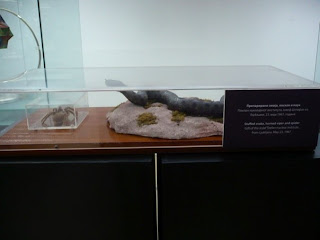


The last one was from the Orthopedic Society - bit creepy... But this did get me thinking about collections in terms of gifts and dictators and how the weirdest collections can often come out of something, such as these gifts, that wasn't originally conceived of as a collection, and how these collections are then used in terms of how we perceive the leader they were given to. One of my most surreal experiences on this subject was on my first trip to Georgia, when in the town of Gori with a friend we went to the Stalin museum. This has to be the most consciously edited museum of someone's life I have ever visited. A highly curated life in fact, maybe the subject for a future post in terms of fame, infamy and public perception and memory. But to briefly make my point here, in the Stalin museum if you did not know your history, you would come out thinking that Stalin was a surprisingly okay looking in his youth revolutionary poet, who world leaders gave lots of presents, and then he died. No mention of the millions of deaths! And these presents are displayed as if somehow them being together like this is a collective proof that other leaders must have not thought that badly of him. Propaganda and rewriting of memory through accumulation of gifts and the inadvertent creation of a collection. Something to think about...

Made every year as part of his birthday celebrations the batons travelled from all over Yugoslavia to be delivered to Belgrade, as part of a mass relay race. I have even heard tales of them arriving by daring feats such as absailing and helicopters! There was an official baton each year, but what I love are the thousands (literally - there are 22,000 batons in this collection and it is rumoured that he was given more during his lifetime!) made by individuals or small groups, which are often deeply surreal. I love how an official collection of a world leader can contain so many things that would normally seem more at home in a homemade collection in an individual's house or a school art display. There is a real quirky individualism in them, which I find fascinated in the context of a communist regime. Below are some wonderful examples I took photos of.


As well as the batons the 25th May Museum has an amazing selection of gifts given to Tito, including many by official organisations. Whilst one's preconception of an official gift to a leader would make one think of mainstream safe choices (though the British government's slightly surreal gift of place mats to the Queen recently might dispel that...), these gifts to Tito are almost like mini collections in themselves - surreal cabinets of curiosities, each like something lost from a mythical museum or eccentric's collection. And the potential for stories behind them too fascinates me - why did the Nuclear Institute give him a taxidermy snake and spider? Why do official organisations choose the things they do to represent them in official gifts? I think you'll find the selection below interesting in terms of this question!


The last one was from the Orthopedic Society - bit creepy... But this did get me thinking about collections in terms of gifts and dictators and how the weirdest collections can often come out of something, such as these gifts, that wasn't originally conceived of as a collection, and how these collections are then used in terms of how we perceive the leader they were given to. One of my most surreal experiences on this subject was on my first trip to Georgia, when in the town of Gori with a friend we went to the Stalin museum. This has to be the most consciously edited museum of someone's life I have ever visited. A highly curated life in fact, maybe the subject for a future post in terms of fame, infamy and public perception and memory. But to briefly make my point here, in the Stalin museum if you did not know your history, you would come out thinking that Stalin was a surprisingly okay looking in his youth revolutionary poet, who world leaders gave lots of presents, and then he died. No mention of the millions of deaths! And these presents are displayed as if somehow them being together like this is a collective proof that other leaders must have not thought that badly of him. Propaganda and rewriting of memory through accumulation of gifts and the inadvertent creation of a collection. Something to think about...

Tuesday, 19 February 2013
The curating impulse - childhood collections.
I've been thinking a lot lately about whether curation, which is so often seen as some official museum and therefore in someways an artificial occupation, is actually quite an intuitive impulse that starts when we are quite young. I'm sure everyone reading this probably at some point in their childhood had a collection, whether it was ceramic frogs or troll toys or marbles or, as in my case, My Little Ponies (I had 37 and they were my most cared for possessions). I also remember being given, by my great aunt who lived most of her life in India, a selection of clay dolls representing every region's traditional dress, and I somehow knew that these were to be treasured and displayed together and looked after. That somehow this group of objects was stronger as a whole and represented something more than a random pile of stuff. I still have them to this day, kept carefully together in a box, and somehow the fact that I first had them and displayed them as a child, makes there significance as a collection even more valuable and apparent to me.
But I also think that childhood collections and what I would call the curating impulse are important, as they are when we first start to create something that is especially our own, that is unique to us. This can be incredibly important when growing up. I remember when I was little and the only girl with two brothers and surrounded by male cousins, there was something about having a collection that was just mine - that they wouldn't steal and play with - that was my own little world I could retreat in, that was incredibly soothing. It made me happy and it made me value things. It also wasn't a static collection but something I could always take with me - to school or more likely roaming the local fields and woods as I did. It was like a portable dream world, that also taught me to value things. I think early collections are also hugely important in terms of our creative development - the stories and games we make up around these possessions. We learn that objects can be the inspiration - the catalyst that takes us into dream worlds. For example I remember being desperate for Flower Fairies as I was sure that if I collected these they would take me to a new imaginary magical world. Now one could be cynical and say the marketing people had succeeded, but it wasn't so much about possession as creation and escapism - enabling even further realms for the imagination to travel to. I don't mind consumerist marketing working if that is the result.
I also think there is something about childhood collections that represents hope and aspiration. I remember collecting an entire grooming kit for a horse I would never have. I went to saddle shops and bought a hay net and a head collar, even though I had no horse to use these things. But that didn't really matter as this collection, rather than a heap of pointless unused objects, represented my dreams and in themselves allowed me dream even more - to feel that my aspiration of owning a horse was somehow not out of reach. Maybe this is how collections function throughout our lives - they give us something we dream of - whether literally or in terms of how they bring dreams closer. And as an adult the memories of these childhood collections still hold an importance - I am a bit of a hoarder but can usually take to charity shops stuff I've bought as an adult but no longer need, but these childhood collections I could never chuck away as they now seem to hold both memories and the hope that they represented. The smell of unused saddle soap still makes me feel optimistic. I have a basket of marbles that seems to hold as many memories and feelings as a teenage diary might have.

And now? Well now I sort of collect lots of things - from my guilty Chie Mihara shoe habit that I can't afford, to old travel guides, vintage Textron ads, 1930s tea sets, holiday souvenir jewellery, vintage dresses, random found objects, found photo albums, lots of moomin things, old embroidered pictures... But do any of them make me feel as emotional as a bag of marbles and a plastic pony? Probably not... (Applejack was my favourite).

Here at museeme I'd be really interested to hear about anyone's childhood collections. If you have one you'd like to share in photos, stories or just memories, do write and let me know. I would like this to be a recurring feature.
But I also think that childhood collections and what I would call the curating impulse are important, as they are when we first start to create something that is especially our own, that is unique to us. This can be incredibly important when growing up. I remember when I was little and the only girl with two brothers and surrounded by male cousins, there was something about having a collection that was just mine - that they wouldn't steal and play with - that was my own little world I could retreat in, that was incredibly soothing. It made me happy and it made me value things. It also wasn't a static collection but something I could always take with me - to school or more likely roaming the local fields and woods as I did. It was like a portable dream world, that also taught me to value things. I think early collections are also hugely important in terms of our creative development - the stories and games we make up around these possessions. We learn that objects can be the inspiration - the catalyst that takes us into dream worlds. For example I remember being desperate for Flower Fairies as I was sure that if I collected these they would take me to a new imaginary magical world. Now one could be cynical and say the marketing people had succeeded, but it wasn't so much about possession as creation and escapism - enabling even further realms for the imagination to travel to. I don't mind consumerist marketing working if that is the result.
I also think there is something about childhood collections that represents hope and aspiration. I remember collecting an entire grooming kit for a horse I would never have. I went to saddle shops and bought a hay net and a head collar, even though I had no horse to use these things. But that didn't really matter as this collection, rather than a heap of pointless unused objects, represented my dreams and in themselves allowed me dream even more - to feel that my aspiration of owning a horse was somehow not out of reach. Maybe this is how collections function throughout our lives - they give us something we dream of - whether literally or in terms of how they bring dreams closer. And as an adult the memories of these childhood collections still hold an importance - I am a bit of a hoarder but can usually take to charity shops stuff I've bought as an adult but no longer need, but these childhood collections I could never chuck away as they now seem to hold both memories and the hope that they represented. The smell of unused saddle soap still makes me feel optimistic. I have a basket of marbles that seems to hold as many memories and feelings as a teenage diary might have.

And now? Well now I sort of collect lots of things - from my guilty Chie Mihara shoe habit that I can't afford, to old travel guides, vintage Textron ads, 1930s tea sets, holiday souvenir jewellery, vintage dresses, random found objects, found photo albums, lots of moomin things, old embroidered pictures... But do any of them make me feel as emotional as a bag of marbles and a plastic pony? Probably not... (Applejack was my favourite).

Here at museeme I'd be really interested to hear about anyone's childhood collections. If you have one you'd like to share in photos, stories or just memories, do write and let me know. I would like this to be a recurring feature.
Curating Kazbegi - a journey along the Georgian Military Highway
As a writer who does a lot of site-specific work as well as a huge fan of travel writing, walking as art and an urban theory geek, the idea of curating a journey as a form of virtual museum - an ephemeral museum that can never wholly be reproduced - is fascinating to me. So my first offering to museeme is just that - a curation of the day I gatecrashed a tour guide trainee day trip by marshrutka (transit van/minibus) up the Georgian military to Kazbegi - village high up in the Caucasus, old gateway to Russia, home of a famous monastery on a hill, mythical last resting place of Prometheus. All photos my own, taken April 2008.

Hurtling out of Tbilisi on a sunny may day on deceptively reassuring roads after about an hour (I think - memory distorts such things) we came to Ananuri and its beautiful church. Ancient seat of the Eristavis of Aragvi we only lingered long enough to don a headscarf and pay our respects.
 We passed by a battle of rivers black and white.

Hot springs painting the climbing earth.

Growing mountains.


Krestovsky Pereval Belvedere - this is where mosaics compete for the view...

Curating a view with ideology? Who wins? We left...

Waved hello to the mist ghosts...

Church barns for horses...

Breathing rock up to snow...
 Kazbegi. We arrived. The marschrutka broke. A young man with witch green eyes and a cigarette tongue laughed but wanted to help. You must climb, he smiled.


Past houses and pig friends.

 It's getting closer!

Snow descended like mist as we reached the top.
Mount Kazbek lost in clouds and mythology, no voyeurism of chains and pecked livers of an ancient imagination. Just peace, and beauty, and cold white snow.
I will never forget how we got down again. Stumbled past confused monks, ankles bare through knee deep snow, and misguided canvas shoes soaked through, freezer wet, we ran, clung to branches, broke our fall with laughter and feet skiing and momentum of not caring what happened any more. Just to get down. To get warm. To drink coffee and cha cha fire up our throats, before hitching a ride on someone else's bus, back through the magic all clouded now. No view to chasms. No room for fear of crashes. Tbilisi, we are nearly home.
I was reading a short intro yesterday, by Tea Obreht to a photo essay of Clarisse d'Arcimoles. She talks of a revelation when a boy said to her "I don't need the picture, I have the memory." She started to question all her ideas of images and memory and photos - whether a photo can ever capture a memory, or is it rather too elusive? Is it simply futile to try and let others share in our memories or to understand there's by looking at photos, if the memory is something of its own, something personal and unknowable to anyone else no matter how much they try? Maybe this is very true - I agree that it is impossible to sum up a person or a moment, an experience, in a single frame. However in some ways the fact that we can never really know a memory as represented by its image makes it more interesting in terms of curating for me - you can set an image free - something that is so evocative for one person, an integral part of what shaped their life, can become something totally different for someone else - the start of a story or the trigger of an idea. The inspiration for new thought or feeling through an emotional response. This is just as valid and can make a selection of photos a museum no one can ever know in whole as it lives in all its viewers heads - the stories they have read into them. Not so much death of the author, as reincarnation of memories. Could this be said for all museums and exhibitions?

Hurtling out of Tbilisi on a sunny may day on deceptively reassuring roads after about an hour (I think - memory distorts such things) we came to Ananuri and its beautiful church. Ancient seat of the Eristavis of Aragvi we only lingered long enough to don a headscarf and pay our respects.


Hot springs painting the climbing earth.

Growing mountains.


Krestovsky Pereval Belvedere - this is where mosaics compete for the view...

Curating a view with ideology? Who wins? We left...

Waved hello to the mist ghosts...

Church barns for horses...

Breathing rock up to snow...


Past houses and pig friends.


Snow descended like mist as we reached the top.
Mount Kazbek lost in clouds and mythology, no voyeurism of chains and pecked livers of an ancient imagination. Just peace, and beauty, and cold white snow.
I will never forget how we got down again. Stumbled past confused monks, ankles bare through knee deep snow, and misguided canvas shoes soaked through, freezer wet, we ran, clung to branches, broke our fall with laughter and feet skiing and momentum of not caring what happened any more. Just to get down. To get warm. To drink coffee and cha cha fire up our throats, before hitching a ride on someone else's bus, back through the magic all clouded now. No view to chasms. No room for fear of crashes. Tbilisi, we are nearly home.
I was reading a short intro yesterday, by Tea Obreht to a photo essay of Clarisse d'Arcimoles. She talks of a revelation when a boy said to her "I don't need the picture, I have the memory." She started to question all her ideas of images and memory and photos - whether a photo can ever capture a memory, or is it rather too elusive? Is it simply futile to try and let others share in our memories or to understand there's by looking at photos, if the memory is something of its own, something personal and unknowable to anyone else no matter how much they try? Maybe this is very true - I agree that it is impossible to sum up a person or a moment, an experience, in a single frame. However in some ways the fact that we can never really know a memory as represented by its image makes it more interesting in terms of curating for me - you can set an image free - something that is so evocative for one person, an integral part of what shaped their life, can become something totally different for someone else - the start of a story or the trigger of an idea. The inspiration for new thought or feeling through an emotional response. This is just as valid and can make a selection of photos a museum no one can ever know in whole as it lives in all its viewers heads - the stories they have read into them. Not so much death of the author, as reincarnation of memories. Could this be said for all museums and exhibitions?
Monday, 18 February 2013
Introduction
Everything has to start somewhere - whether it's a conversation a story or a collection. I've faffed about how to do this more times than I can remember when beginning essays, or novels - poems aren't usually so difficult - they just happen. But it seemed right therefore to write something before launching into the random collection of posts, that hopefully in its own way will become some form of museum too - a curation of ideas, collections, stories and people that will represent what museeme hopes to become.
I have always been fascinated by personal archives, collections, cabinets of curiosity, the hidden stories of objects and the times they have lived through. It comes up again and again in my creative workshops too - how many times have I used an object, whether in an existing museum or something simply found, as the starting point to encourage other people's writing - encouraged them to imagine the secret history of this object and what is might have seen? I find it endlessly fascinating that something we define as inanimate can actually contain so much life - real and imagined - and that both the real and imagined have value in terms of what the object means to both the world and an individual. Can we ever really define the meaning of an object? This ties in with the issue of curating and how the meaning of objects evolves with the context they are put in. Is each curator retelling the story of an object? If that can happen in an official museum context, is it not also happening in everyone's lives when they put objects and thoughts together, whether a serious or quirky collection, or something as simple and everyday as the placement of objects on a table or clothes in a wardrobe? In a virtual world that has become so obsessed with the surface and transitory meaning of things and the instant throwaway nature of images, I wanted to create a space that delves deeper - where even the seemingly throwaway can have a story - where the everyday can be curated as well as the established historically significant.
I have also always been interested in the hundreds of small museums around the world that many won't have heard of unless they are local. This blog will also seek to track some of these down and to open up their collections to a wider world. I am also interested in the collections of individuals, so these too will be featured. I see all collections of objects as potential museums, but also my love of site-specific work and of travelling makes me want to broaden this definition even further, to include the curation of places, old photos, moments in time, diaries, travel journals, memories... I am interested in the space in between objects and words too - what is there that we cannot see that adds to a story. Who is the audience in this new definition of museum? Can we curate anything? Sounds... Words... Feelings...
Museeme will explore all these questions whilst showcasing every definition of museum possible. It will also be a space for reviews of interesting relevant books and exhibitions, interviews with ordinary individuals with something they have curated, as well as archivists, artists and deep thinkers. It is also a blog that welcomes the input of all of its readers - if you have your own museum or project you want to share - from a few random found objects to a body of creative work - do write to me and I will try and feature you.
The world is a museum and everyone is its curator, and that is the spirit of museeme.
I have always been fascinated by personal archives, collections, cabinets of curiosity, the hidden stories of objects and the times they have lived through. It comes up again and again in my creative workshops too - how many times have I used an object, whether in an existing museum or something simply found, as the starting point to encourage other people's writing - encouraged them to imagine the secret history of this object and what is might have seen? I find it endlessly fascinating that something we define as inanimate can actually contain so much life - real and imagined - and that both the real and imagined have value in terms of what the object means to both the world and an individual. Can we ever really define the meaning of an object? This ties in with the issue of curating and how the meaning of objects evolves with the context they are put in. Is each curator retelling the story of an object? If that can happen in an official museum context, is it not also happening in everyone's lives when they put objects and thoughts together, whether a serious or quirky collection, or something as simple and everyday as the placement of objects on a table or clothes in a wardrobe? In a virtual world that has become so obsessed with the surface and transitory meaning of things and the instant throwaway nature of images, I wanted to create a space that delves deeper - where even the seemingly throwaway can have a story - where the everyday can be curated as well as the established historically significant.
I have also always been interested in the hundreds of small museums around the world that many won't have heard of unless they are local. This blog will also seek to track some of these down and to open up their collections to a wider world. I am also interested in the collections of individuals, so these too will be featured. I see all collections of objects as potential museums, but also my love of site-specific work and of travelling makes me want to broaden this definition even further, to include the curation of places, old photos, moments in time, diaries, travel journals, memories... I am interested in the space in between objects and words too - what is there that we cannot see that adds to a story. Who is the audience in this new definition of museum? Can we curate anything? Sounds... Words... Feelings...
Museeme will explore all these questions whilst showcasing every definition of museum possible. It will also be a space for reviews of interesting relevant books and exhibitions, interviews with ordinary individuals with something they have curated, as well as archivists, artists and deep thinkers. It is also a blog that welcomes the input of all of its readers - if you have your own museum or project you want to share - from a few random found objects to a body of creative work - do write to me and I will try and feature you.
The world is a museum and everyone is its curator, and that is the spirit of museeme.
Subscribe to:
Posts (Atom)